
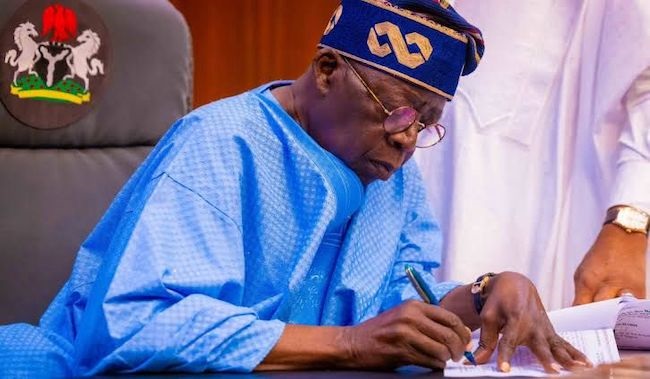
The Independent Media and Policy Initiatives (IMPI) has said that President Bola Tinubu caused a turnaround in Nigeria’s economy by deploying tools of economic progressivism.
In a policy statement signed by its Chairman Dr Omoniyi Akinsiju, IMPI argued that it was the best of way of weaning the country off decades of profligacy.
It said, “Like the USA, Nigeria has had periods of decadent public value and normalisation of profligacy in high offices.
“Before the economic reforms initiated by President Bola Ahmed Tinubu in May 2023, the Nigerian economy was characterised by a deeply entrenched oligarchy, where a small group of political elites, military officers, and business moguls controlled state resources.
“This structure was sustained by a patronage system, particularly in the oil sector, which benefited a select few while the majority of the population faced poverty, with 63 per cent (about 133 million people) living in multidimensional poverty by 2022.
“The “pre-reform” economic landscape was defined by several key oligarchic and structural features: A significant portion of the oligarchy benefited from the fuel subsidy system, which was described as being rife with corruption and used as a “feeding bottle” for a select few.
“The existence of multiple exchange rate windows allowed “FX subsidy merchants” to exploit the gap between official and parallel market rates, effectively draining government finances. Economic power was heavily concentrated in the petroleum industry, with access to oil revenues controlled by those in power and their close associates.
“By the time Tinubu took office, Nigeria was spending approximately 97 percent of its total revenue on debt servicing, a situation described as “disastrous”.
“Beyond the oligarchy’s capture of the Nigerian state, we note the obvious decimation of the nation’s fiscal substance before the coming of the ruling All Progressives Congress (APC) to the federal administration in 2015.
“Data show that Nigeria’s export profile changed significantly after 2014, resetting to a lower range that has persisted despite periodic recoveries. Nigeria reached a peak crude oil and gas export value of $93.89 billion in 2011, the highest in the dataset.
“At this time, however, we can submit with much assertion that the federal administration has, indeed, taken Nigeria out of the woods, evidenced by a turnaround economy that shows an indication of stability while unlocking the stranglehold of the oligarchs on the nation’s economy.
IMPI also identified some of the policies and programmes of the Tinubu administration that set the country on the path of economic stability.
“To support our assertion of an ideology-based economic turnaround, we itemise some of the key tools of progressivism that the President Bola Ahmed Tinubu-led federal administration has deployed to accomplish the present feat.
“These include fiscal policy and taxation, redistributive spending, estate and wealth taxes, labour and wealth protection, monetary and financial reforms, infrastructural development, and public investment and ownership,”it said.
The policy group also provided some insights into the impact of economic progressivism on the landscape.
“Allocations from the Federation Account Allocation Committee (FAAC) in 2025 experienced a significant surge, with the three tiers of government sharing over ₦33.27 trillion in the first eleven months, a 30 percent increase over the same period in 2024.
“This growth, driven by subsidy removal and exchange rate reforms, included record monthly distributions, such as ₦3.64 trillion in September 2025, significantly boosting subnational revenue.
“Inflation, while still in double digits, has dropped by over half from a peak of 34.6 percent in November 2024, to 15.10 percent in January 2026 reflecting over nine months of consistent disinflation.
“This has largely restored real purchasing power for households and businesses, with Nigerians now reaping the benefits of the exchange rate unification.
“Nigeria’s food inflation rate eased to 8.89 percent year-on-year in January 2026, this marks its first single-digit reading in 128 months and the lowest level in 174 months. The January 2026 CPI report shows food inflation declined from 29.63 percent recorded in January 2025 to 8.89 percent in January 2026, a sharp 20.73 percentage point year-on-year drop.
“The 8.89 percent reading is the first time food inflation has fallen below 10 percent since May 2015, when it stood at 9.78 percent. January 2026, therefore, ends a stretch of more than 10 years of persistent double-digit food inflation. More significantly, the January figure is the lowest since August 2011, when food inflation was 8.66 percent
“We continue to observe a huge contraction in the gap between the official and parallel market rates which has shrunk from 60 to 2 percent with the naira as of Tuesday, February 24, 2026, trading at approximately ₦1,349.24 to the US Dollar in the official market and between ₦1,355 and ₦1,420 in the parallel (black) market.
“The naira is rated the world’s second-best performing currency this year with a more than 7 percent gain against the dollar,” the policy group noted.
End