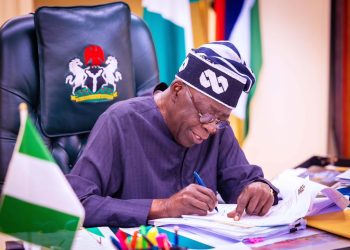

The Tinubu Media Support Group (TMSG) has described the three years of the President Bola Tinubu’s administration as the most peaceful period in Nigeria’s tertiary institutions and the first in almost thirty years in living memory.
This, according to the group, is as a result of a Tinubu-led amicable resolution of a long-standing dispute with academic unions which has ultimately led to the listing of 24 of the Nigeria’s universities in the the latest global ranking of reputable global universities.
In a statement by its Chairman Emeka Nwankpa and Secretary Dapo Okubanjo, TMSG remarked that the administration’s feat in resolving the dispute aligned with the campaign promises of the then Candidate Bola Tinubu in the run- up to the 2023 Presidential election.
It said: “When President Bola Tinubu was on campaign trail before the 2023 election, he was emphatic that a four-year course in the nation’s Universities would not exceed four years, many Nigerians might have felt he was sticking out his neck unnecessarily.
“This was because since 1999, records show that the country had recorded nationwide university shutdowns more than 16 times, totaling over 1,700 days.
“Indeed many Nigerians had a right to be sceptical because strikes in the nation’s universities were an annual ritual which no President before 2023 did not escape.
“It is a matter of public record that at least one incumbent President and his deputy took advantage of one of those prolonged standoffs and shutdowns to establish their private universities which are thriving today to the utter detriment of the nation’s tertiary public education sector.
“But we dare say that President Tinubu has proved to be different and has achieved what the previous four Presidents abysmally failed to do. There has not been a single lengthy nationwide strike in his first three years. This is a commendable feat.
“It is pertinent to note that President Tinubu inherited an intractable agreement with the Academic Staff Union of Universities (ASUU) which was endorsed in 2009 when the country had an oil boom and was supposedly doing well, but was not fully implemented.
“This was one of the reasons Universities were shut down across the country during late President Muhammadu Buhari’s administration for a cumulative period of between 580 and 630 days. In 2022 yhualone, there was an 8-month long shutdown from February to October.
“But with President Tinubu in the saddle, it has been three years of uninterrupted academic work without any university shutdown whatsoever after the government responded to the lecturers’ core demands for a renegotiation of the 2009 FGN-ASUU agreement, the release of revitalisation funds for public universities, and a deployment of the University Transparency and Accountability Solution (UTAS) instead of IPPIS.
“And although there are recent issues over what ASUU termed ‘haphazard implementation of the agreement’ by some state governments, the nation’s university campuses have continued to enjoy seemless academic activities for over 3 years.”
TMSG added that President Tinubu has not only fulfilled his promise on a stable academic calendar, but has also made life easier for students and lecturers.
The group further observed that the informal business community in the tertiary institutions comprising vendors of various goods and services have become major secondary beneficiaries of the positive fallout of the rapprochement achieved by the administration with striking universities and polytevhnics teachers.
“It is safe to say that the President’s campaign promise is as good as fulfilled. And rather than act oblivious to the plight of Nigerian students by setting up private universities to reap the benefit of struggling public tertiary institutions like former Vice President Atiku did in the Obasanjo years, the President is also ensuring that indigent students have the opportunity of staying in school by introducing interest-free student loans.
“At the last count, about 1.6 million students have benefited from Nigeria Education Loan Fund (NELFUND) in only3rd two years of operation while lecturers also now have access to interest-free loans up to N10m, repayable over five years under the Tertiary Institutions Staff Support Fund (TISSF).
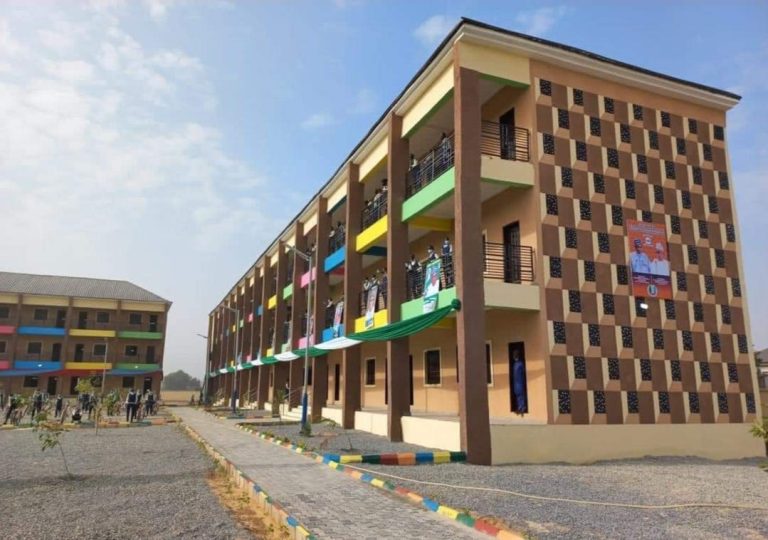
“We are also aware of new infrastructure springing up in public institutions across the country courtesy of the Tertiary Education Trust Fund (TETFund).
“In addition, 24 Nigerian universities are listed in the Times Higher Education World University Rankings on the watch of President Tinubu in 2026, more than the number featured last year. It is instructive that 17 out of them are federal Universities, a development which confirms the sort of attention the administration is placing on raising the profile and quality of tertiary education in the country.
“So there is no way, the administration will not proudly point at the situation in the nation’s universities in the last three years as one of its key achievements,” it added.
The group is convinced that tertiary education in Nigeria would have returned to a pride of place by the time President Tinubu completes his two terms in office.
End